
The Security Mandate: Scaling Technical Support Without Compromising Compliance
Published July 6, 2026
The Security Mandate: Scaling Technical Support Without Compromising Compliance
Rapid growth in the software and financial technology sectors introduces a critical operational tension. On one side, there is the urgent, unrelenting need to scale your customer support capacity to meet escalating ticket volumes. On the other side, there are the strict, unyielding demands of data privacy, regulatory compliance, and complex product nuance.
For SaaS Founders, FinTech Operations Leaders, and Security Compliance Officers, handing over access to proprietary backend systems and sensitive user data is a terrifying prospect. The stakes are incredibly high. A single data breach or compliance violation can result in catastrophic financial penalties and permanent reputational damage.
This tension is exactly why traditional scaling methods fail. Standard offshore call centers cannot handle the regulatory rigor required by modern technology companies. To scale securely, organizations must adopt a modern approach to technical support outsourcing—one that prioritizes zero-trust infrastructure, rigorous compliance, and elite technical proficiency.
Here is how industry-leading companies build scalable, highly secure support ecosystems that protect user data while crushing their Service Level Agreements (SLAs).
The Trust Deficit in Traditional IT Help Desk Outsourcing
Historically, IT help desk outsourcing has been viewed with skepticism by compliance and security teams. The legacy model relies on shared agent pools, where support representatives jump between different client accounts on unsecured local networks.
In these outdated environments, data hygiene is virtually non-existent. Agents may download sensitive client logs to local hard drives, utilize unencrypted messaging platforms, or access financial backend portals over public IP addresses. For a modern tech company handling Personally Identifiable Information (PII) or Payment Card Industry (PCI) data, this model is a massive, unacceptable vulnerability.
Scaling operations safely requires abandoning the shared-pool model entirely. It requires a foundational shift toward infrastructure engineered specifically for compliance.
Architecting a Data Security First Infrastructure
To mitigate risk, your support operations must adopt a data security first posture. This means that before a single ticket is answered or a single workflow is mapped, the digital and physical infrastructure must be hardened to meet strict enterprise standards (such as SOC 2 Type II, GDPR, and ISO 27001).
Deploying Isolated Digital Environments
Secure outsourcing partners do not allow agents to access your systems via standard web browsers on personal devices. Instead, they deploy strict, isolated digital environments.
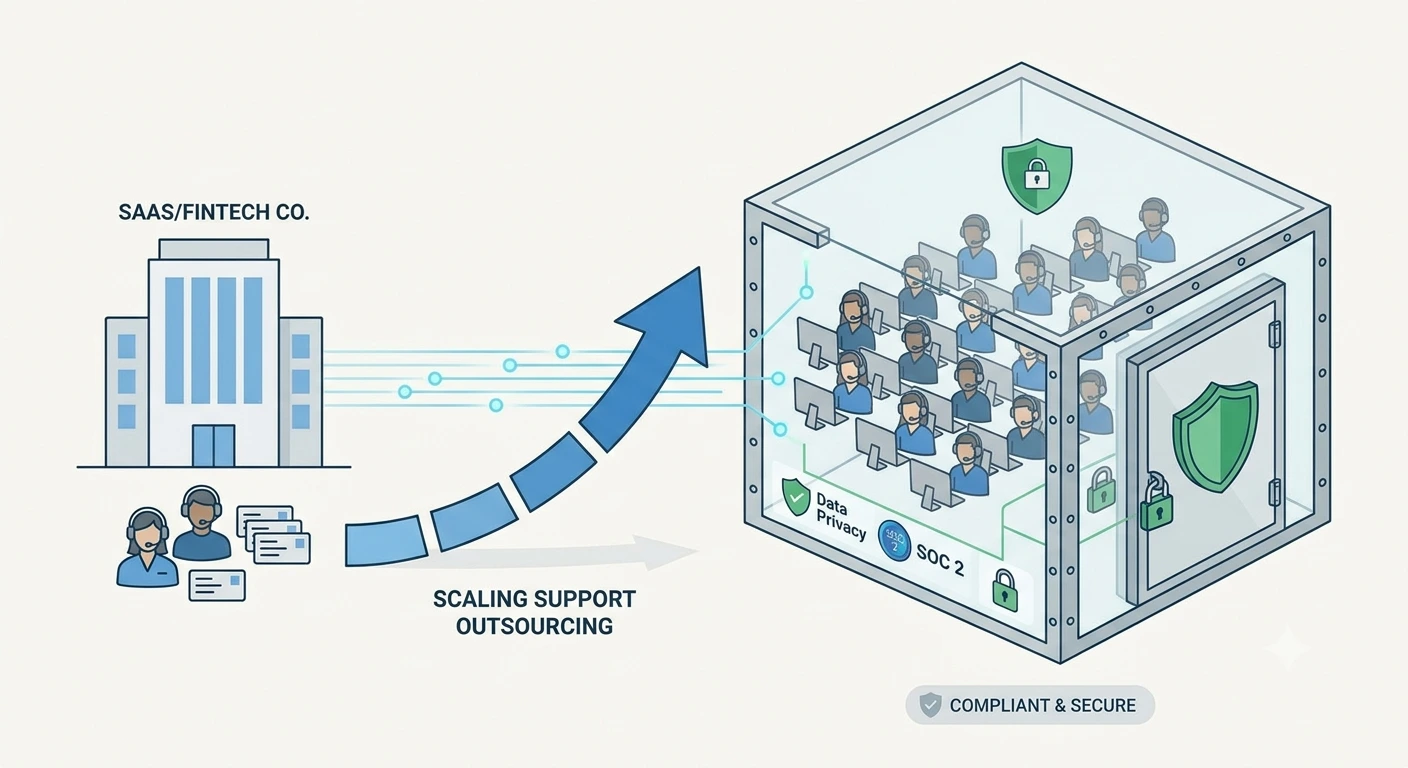
By utilizing Virtual Desktop Infrastructure (VDI) and Zero-Trust Network Access (ZTNA), the outsourced team accesses a sealed, company-controlled workspace. Data never physically resides on the agent’s local machine; it remains entirely within your secure cloud infrastructure.
To ensure rigorous data protection, a secure support deployment must mandate the following protocols:
- Multi-Factor Authentication (MFA) & Single Sign-On (SSO): Enforcing cryptographic hardware keys or biometric authentication for all system access.
- Role-Based Access Control (RBAC): Restricting agent permissions based on the principle of least privilege, ensuring they only see the data strictly necessary to resolve the immediate ticket.
- Endpoint Device Management: Utilizing Mobile Device Management (MDM) to disable USB ports, prevent copy/paste functions, and block unauthorized screen capture software on agent workstations.
- Encrypted Data Pipelines: Mandating TLS 1.3 encryption for all data in transit between the helpdesk platform and proprietary backend databases.
Managing Complex Technical Ticket Queues
Once the infrastructure is secured, the focus shifts to operational execution. SaaS customer support and FinTech customer support are vastly different from standard retail eCommerce.
Your users are often developers, system administrators, or financial analysts. When they submit a ticket, they aren't asking for a password reset; they are submitting complex API payload errors, querying misconfigured webhook endpoints, or troubleshooting failed payment gateway reconciliations.
Handling these complex technical queues requires agents who understand the underlying architecture of your product. Your outsourced partner must invest heavily in rigorous, product-specific onboarding. Support engineers need to be trained not just on your helpdesk software, but on how to read your internal server logs, navigate your cloud environments, and effectively reproduce bugs for your internal engineering team.
Reducing Customer Effort Scores (CES) Through Expertise
In complex technical environments, Customer Satisfaction (CSAT) is heavily influenced by the Customer Effort Score (CES). If a user has to explain their highly technical issue three different times to three different entry-level agents before finally reaching someone who understands the problem, your CES will skyrocket, and churn will inevitably follow.
The most effective way to reduce CES is by deploying a dedicated remote team.
Unlike a shared pool, a dedicated team works exclusively for your brand, 40 hours a week. They attend your internal product sprint reviews, communicate directly with your tier-3 engineering channels via Slack, and become fluent in your specific brand voice. Because they are deeply embedded in your operational culture, they act as a seamless extension of your in-house team. They can diagnose complex issues rapidly, resulting in faster First Contact Resolutions (FCR) and a frictionless experience for your users.
SLA Support Management: Engineering Predictability
Security and technical expertise mean very little if your team cannot consistently meet their operational targets. For enterprise clients, Service Level Agreements (SLAs) are legally binding commitments.
Rigorous SLA support management requires real-time workforce analytics and dynamic queue routing. A premium outsourced partner will implement sophisticated escalation matrices, ensuring that critical, severity-1 infrastructure outages are instantly routed to senior technical leads, while standard configuration queries are handled by tier-1 specialists.
By continuously monitoring response times, resolution velocity, and quality assurance metrics within a secure environment, operations leaders can guarantee peak performance without ever compromising data integrity.
Scale Your Operations with Total Confidence
Balancing the need for rapid operational expansion with the absolute necessity of data security is the defining challenge for modern technology leaders. You do not have to choose between scaling your support and protecting your users.
By demanding isolated digital infrastructure, specialized technical training, and rigorous compliance standards, you can build a highly efficient, global support ecosystem that actually fortifies your brand's reputation.
Are you ready to scale your technical support without the security anxiety?
Stop settling for vulnerable, legacy call centers. Reach out today to discover how AYSO Operations builds highly secure, deeply integrated, and strictly dedicated offshore support teams engineered specifically for SaaS and FinTech innovators.