
The True Cost of Scaling: In-House Support Operations vs. Managed BPO
Published July 6, 2026
The True Cost of Scaling: In-House Support Operations vs. Managed BPO
When a company enters a high-growth phase, building out internal customer operations feels like the logical next step. Leadership teams naturally calculate the cost of expanding based on a simple formula: hourly wage multiplied by the number of new seats.
However, looking strictly at raw employee salaries creates a dangerous financial blind spot. For startup founders, CEOs, and CFOs, running a local, in-house support team introduces massive, hidden structural liabilities. Rising local infrastructure overheads, strict workplace compliance laws, equipment sourcing costs, and heavy payroll administration burdens quietly erode your company’s bottom line.
Every dollar spent managing localized operational friction is a dollar stolen from your core product development. To protect your margins and scale sustainably, you must understand the true cost of ownership (TCO) of your helpdesk. Transitioning to a modern, fully managed model of business process outsourcing eliminates these structural leaks and lets you reinvest heavily in your company’s future.
Here is an analytical breakdown of why managing your support infrastructure internally caps your growth, and how a managed partner changes the financial equation.
Local vs. Remote Cost Sheets: The Real Overhead
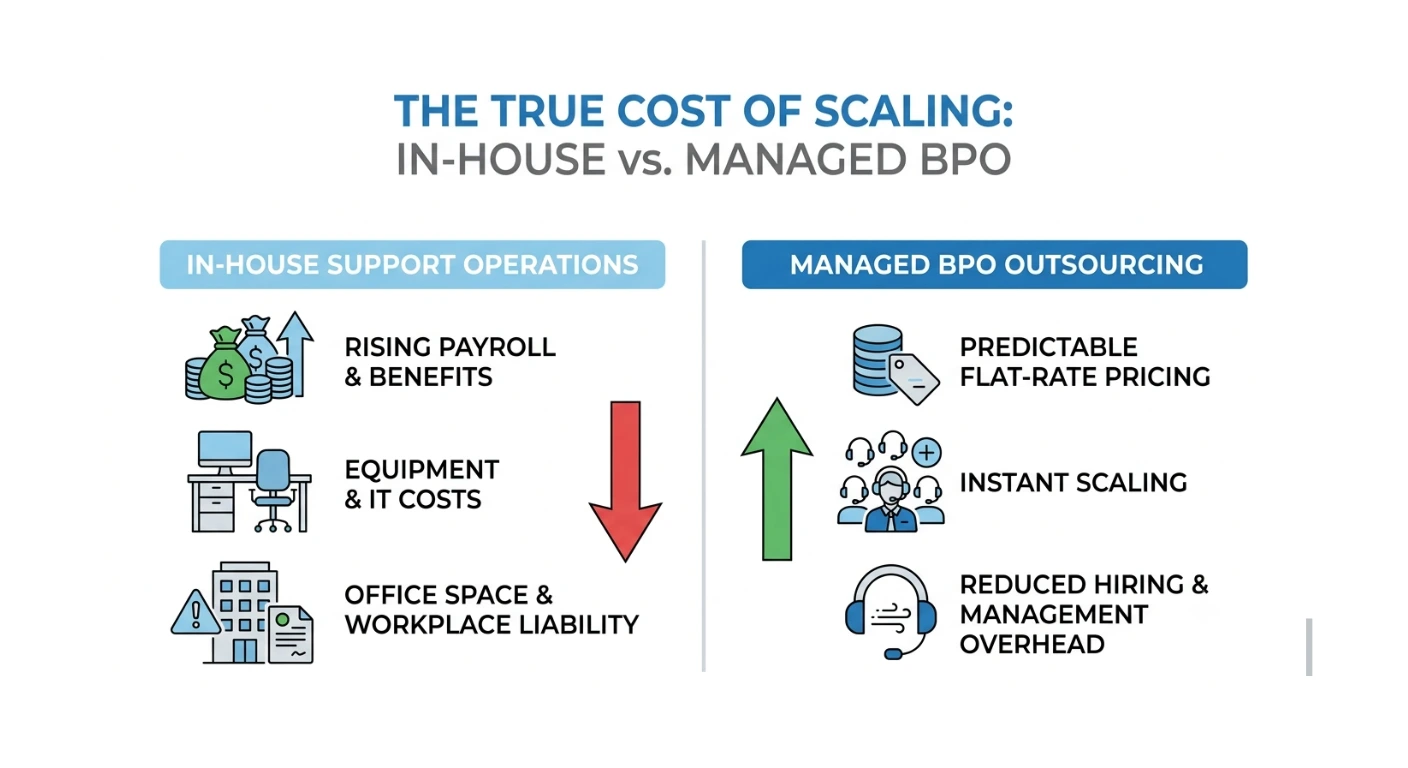
To truly understand how an internal operation drains your resources, you have to look beyond the basic paycheck. Every full-time internal hire adds massive "burden costs" that have nothing to do with resolving customer inquiries.
When you build an in-house team, you absorb the full weight of localized employer liability. This includes providing healthcare benefits, retirement matching, paid time off (PTO), and workers' compensation insurance. These benefits typically add 25% to 40% on top of an employee's base salary.
Furthermore, the physical and digital infrastructure required to support local workers is incredibly expensive. You must handle enterprise software licensing—where helpdesk tools, internal chat apps, and CRM seats charge premium rates per user. When you add upfront capital expenditures (CapEx) for secure, high-performance laptops, dual monitors, and workspace utilities, the cost sheet quickly balloons out of control.
The Expense Profile: In-House vs. Managed Support
To visualize this operational difference, consider how the traditional internal support setup stacks up against a modern, flat-rate model:
| Cost Vector | The In-House Support Setup | The Managed BPO Model |
|---|---|---|
| Recruitment & Hiring | High internal HR hours, job board fees, background check costs. | Included natively; zero recruitment fees to your brand. |
| Equipment & IT Security | Upfront CapEx for hardware, MDM software, secure routing setup. | Completely offloaded; partner provisions all hardware securely. |
| Software Licensing | Linear cost growth per user seat across your entire tech stack. | Optimized by the partner through enterprise-scale billing. |
| Workplace Liability | 100% exposure to local labor laws, benefits, payroll tax compliance. | Zero localized liability; insulated by the partner's legal footprint. |
| Coverage Gaps | Overtime pay for nights/weekends; lost CSAT during sick leaves. | 24/7/365 coverage built in natively with zero extra costs. |
Dropping Operational Friction by Outsourcing Recruitment
The talent acquisition cycle is a massive, invisible drag on executive focus. When you try to outsource business operations by manually building a local team, your HR managers spend weeks sourcing resumes, vetting candidates, and conducting multi-stage interviews.
Because entry-level support roles endure some of the highest turnover rates of any corporate department, this recruitment cycle never actually stops. The moment a local agent leaves, your upfront training investment is wiped out, and your remaining agents are forced to absorb compounding ticket volumes. This triggers a toxic feedback loop: agent burnout accelerates, response times spike, and customer satisfaction drops.
When you partner with an elite remote staffing agency or a managed services provider, you eliminate this entire logistical headache. The partner absorbs 100% of the re-hiring and re-training friction. If an agent moves on or calls out sick, a deeply redundant team covers the gap instantly. Your queues stay fully staffed, ensuring absolute continuity without dragging your management team into daily HR logistics.
The Strategic Advantage of a Global Delivery Model
Attempting to provide authentic weekend, holiday, and overnight coverage locally means paying highly inflated shift premiums just to keep the lights on.
Modern enterprise scaling relies on a robust global delivery model. By distributing operational hubs across highly secure, geographically diverse regions, a managed partner delivers elite support around the clock. This isn't just about saving money on wages; it is about building continuous, seamless service.
Your business gains a dedicated remote team that operates under strict performance metrics from day one. Because the partner handles regional payroll compliance, local labor laws, and management oversight across different time zones, your executive team stays completely insulated from international operational friction. You get flat, highly predictable monthly billing, paying for reliable output and coverage rather than individual idle time.
Turning Enterprise-Grade Infrastructure Into a Competitive Advantage
Exceptional managed customer support does not just cut costs—it transforms your customer experience (CX) into a powerful engine for retention.
When you utilize specialized BPO services, you gain access to an enterprise-grade technology setup that would cost hundreds of thousands of dollars to build internally. This includes advanced workflow automation, AI-driven quality assurance auditing, and highly optimized ticket routing pipelines.
Because the partner handles the technological configurations and continuous education, your brand is consistently represented by highly trained professionals. Issues are resolved on the first touch, resolution timelines drop from days to minutes, and your customers experience flawless service quality even during your most volatile growth spikes.
Fueling Long-Term Scaling and Growth
Your business shouldn't be trapped in the complex, high-stakes logistics of running a localized call center. Every hour your leadership team spends reviewing support applications, troubleshooting hardware issues, or managing rotating graveyard shift schedules is an hour stolen from executing your core strategic goals.
By shifting to a fully managed model, you convert unpredictable scaling costs into a flat, reliable line item. You protect your margins, eliminate employer liability, and secure the vital business growth support needed to dominate your market. Let the operational experts engineer the helpdesk, so you can focus entirely on scaling your revenue.
Ready to stop overpaying for support overhead and see how much you can save?
Don't let hidden liabilities anchor your growth. Get a flat-rate custom proposal from AYSO Operations today, and discover how our fully managed infrastructure can streamline your bottom line.