The Blueprint for Consistency: Building SOPs and Knowledge Bases That Scale
Published July 6, 2026
The Blueprint for Consistency: Building SOPs and Knowledge Bases That Scale
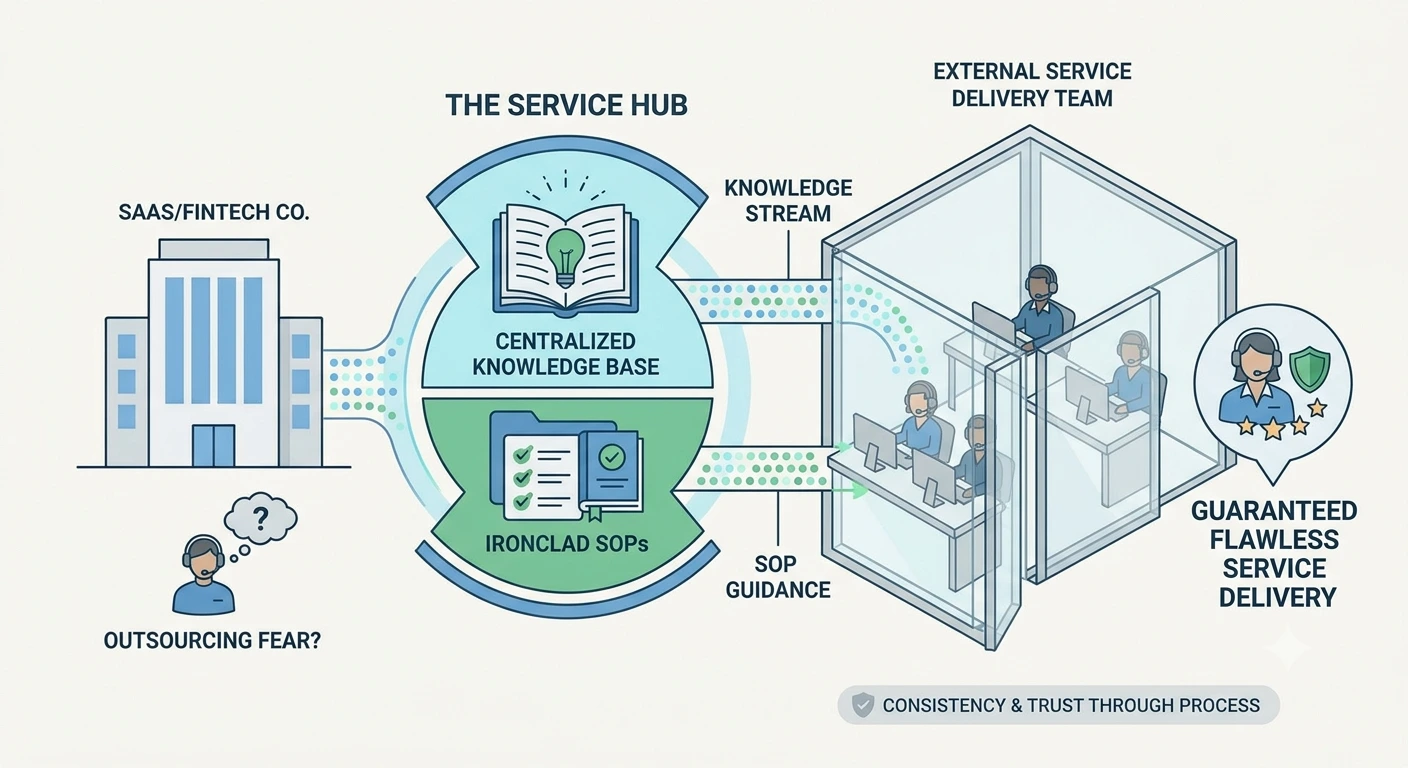
For Operations Directors, Customer Success Managers, and Growing Business Owners, outsourcing customer service often feels like stepping onto a high-wire without a safety net. The fear is visceral and completely justified: Will external agents truly understand the technical nuance of our product? Will they know how to match our exact brand voice? What happens when a complex edge-case arises?
The nightmare scenario is a decentralized, inconsistent support experience where agents guess at solutions, ultimately frustrating your customers and damaging the reputation you worked so hard to build.
However, the antidote to this fear is not stubbornly keeping every single operation in-house until your local team burns out. The true solution is operational engineering. Guaranteeing customer service excellence across any team—internal or external—requires building centralized internal knowledge bases and ironclad standard operating procedures (SOPs). When you remove the guesswork from your workflows, you completely eliminate the risk of outsourcing.
Here is the authoritative guide to building documentation that empowers your team, guarantees consistency, and scales your service delivery flawlessly.
The Foundation: Why Ironclad Documentation is Non-Negotiable
A support agent is only as effective as the information they have access to. If your institutional knowledge lives solely inside the heads of your senior staff, or is scattered across dozens of unorganized Google Docs and Slack threads, your operations will fracture the moment ticket volume spikes.
Robust documentation shifts the burden of memory away from the human and onto the system. By leveraging professional standard operating procedures (SOP) services or dedicating internal resources to document creation, you build a resilient foundation. Every macro, every return policy, and every technical troubleshooting step must be explicitly defined. This creates a single source of truth that ensures a customer gets the exact same high-quality answer whether they email you on a Tuesday morning or a Sunday night.
Mapping Workflows into Notion (and Modern Wikis)
To make your documentation actually usable, it must be centralized, searchable, and highly visual. Modern operations teams have moved away from static PDFs and embraced dynamic wiki platforms like Notion, Confluence, or Slite to house their infrastructure.
When mapping your support workflows into a centralized wiki, you must optimize for speed. An agent handling a live chat does not have time to read a five-page essay. They need structured, easily scannable knowledge base support.
Follow this standard operational framework when mapping your SOPs:
- The "If/Then" Decision Tree: Break down complex problems into binary choices. (e.g., If the customer’s payment failed, check Stripe. If the error code is X, execute workflow Y.)
- Visual Anchors: Embed direct screenshots, GIFs, and short screen-recordings showing the exact buttons to click within your backend software.
- The "TL;DR" Summary: Place a three-bullet-point summary at the very top of every SOP document for agents who just need a quick memory refresher.
- Tagging and Taxonomy: Use robust tagging systems so agents can instantly pull up related articles by searching for specific product features or error codes.
Running Rigorous Operational Boot Camps
Having an incredible Notion workspace means nothing if your team doesn't know how to navigate it under pressure. This is where elite customer support training bridges the gap between passive documentation and active service delivery.
When onboarding new agents—especially remote or outsourced teams—do not just hand them a login to your wiki and expect them to learn by osmosis. Instead, run rigorous, structured operational boot camps.
A high-performance boot camp simulates the exact pressure of the live queue. Trainees should spend days navigating mock tickets, role-playing frustrated customer scenarios, and being timed on how quickly they can locate the correct SOP in the knowledge base. This intensive training ensures that when an agent hits the production floor, relying on the documentation is pure muscle memory. They know exactly how to match your brand's specific empathy, tone, and technical precision because they have actively practiced it a hundred times over.
Driving FCR Through Documented SOPs
The ultimate benchmark of an effective knowledge base is its impact on your First Call Resolution (FCR) or First Contact Resolution. When a customer reaches out, they want their problem solved in a single interaction. Every time a ticket has to be escalated to a senior manager or passed to a different department, your customer effort score spikes.
To drive FCR upward, you must adopt a strict metrics-driven approach to your internal documentation.
If your analytics show that a specific type of software bug is consistently taking three or four touches to resolve, your SOP is failing. This data tells your operations leads exactly where to intervene. They must rewrite the troubleshooting documentation for that specific bug, adding clearer steps, more precise API payload examples, or better escalation routing rules. By letting your metrics dictate your documentation updates, your knowledge base becomes a living, breathing engine of continuous improvement.
Elevating Quality with QA Outsourcing
Maintaining this level of perfection requires constant oversight. Many high-growth businesses leverage quality assurance outsourcing to continuously audit their support interactions. Dedicated QA teams review a statistical sample of resolved tickets, grading agents strictly against the documented SOPs. If an agent deviates from the workflow, the QA team flags it immediately, triggering targeted retraining and preventing minor inconsistencies from becoming systemic failures.
Scaling Seamlessly with Digital Operations Outsourcing
Once your internal knowledge base is centralized, your SOPs are ironclad, and your QA frameworks are active, your business becomes truly scalable. You are no longer reliant on individual rockstar employees; you have built a bulletproof system.
With this infrastructure in place, you can confidently leverage digital operations outsourcing to scale your headcount globally. You can hand your Notion playbook to a dedicated, premium offshore team, knowing with absolute certainty that they will execute your workflows with the exact same precision and brand voice as your internal staff. The fear of outsourcing vanishes, replaced by the strategic advantage of fluid, predictable, and highly cost-effective growth.
Systemize Your Success
Delivering exceptional customer experiences at scale is not about luck, and it is not about hiring unicorns. It is about engineering an environment where your agents simply cannot fail because the operational guardrails are too strong.
By investing the time to map your workflows, build dynamic knowledge bases, and run rigorous training boot camps, you transform your customer support department from a volatile cost center into a reliable engine for customer loyalty.
Are you ready to stop guessing and start engineering? Subscribe to our newsletter for more weekly operational insights, deep dives into QA frameworks, and actionable strategies to scale your service delivery seamlessly.