
Why Standard Bots Fail: Architecting True AI-Powered Customer Support
Published July 6, 2026
Picture this: your highest-value customer just spent fifteen minutes stuck in a frustrating doom-loop with your newly deployed digital assistant. They are furiously typing "TALK TO A HUMAN" in all caps, and by the time they finally reach a live agent, their frustration has peaked. The issue isn't even resolved yet, but your Customer Satisfaction (CSAT) score for that interaction is already destined to be a zero.
As an enterprise executive, COO, or Customer Support Director, you have likely felt the sting of this exact scenario. In the rush to scale operations and reduce overhead, many organizations bolt standard, off-the-shelf bots onto their existing infrastructure, expecting instant miracles. But the reality is harsh: deploying AI without deep, authentic business context does not scale your support—it scales customer alienation.
The future of enterprise scalability does not lie in replacing your team with rigid algorithms. True AI-powered customer support requires a synergistic systems approach. It demands a human-in-the-loop operational model that continuously feeds, trains, and refines your artificial intelligence, creating a self-sustaining data pipeline.
Let's explore exactly why standard automation falls short, and how you can engineer a resilient, context-aware ecosystem that actually elevates the customer experience.
The Context Trap: Why Standard AI Chatbot Support Fails
When businesses first invest in AI chatbot support, they usually buy into a localized illusion: the idea that ingesting a few dozen FAQ articles into a Large Language Model (LLM) is enough to resolve complex customer inquiries.
This is the "Context Trap." Standard chatbots operate in a vacuum. They understand syntax, but they entirely lack operational context, historical nuance, and empathy. When a customer writes, "My shipment is late, and I need this for a wedding tomorrow," a standard bot simply reads "late shipment" and regurgitates your standard 5-to-7-day shipping policy. It fails to recognize the urgency, the emotional weight of the event, or the lifetime value of that specific account.
This context-blind approach leads to:
- Escalation Spikes: Customers quickly learn to bypass the bot entirely, flooding your expensive tier-2 and tier-3 human agents with basic queries they just didn't trust the bot to handle.
- Reputational Damage: Treating urgent, high-stakes problems with canned, robotic indifference permanently damages brand loyalty.
- Stagnant Workflows: Off-the-shelf bots don't learn from their mistakes. Without a structured feedback loop, they will fail the exact same way, on the exact same ticket, a thousand times in a row.
To break free from the Context Trap, organizations must shift their mindset. You cannot buy exceptional customer support automation; you have to build it organically using the best data you have—the expertise of your top-performing human agents.
The New Standard: Building the Support Data Pipeline
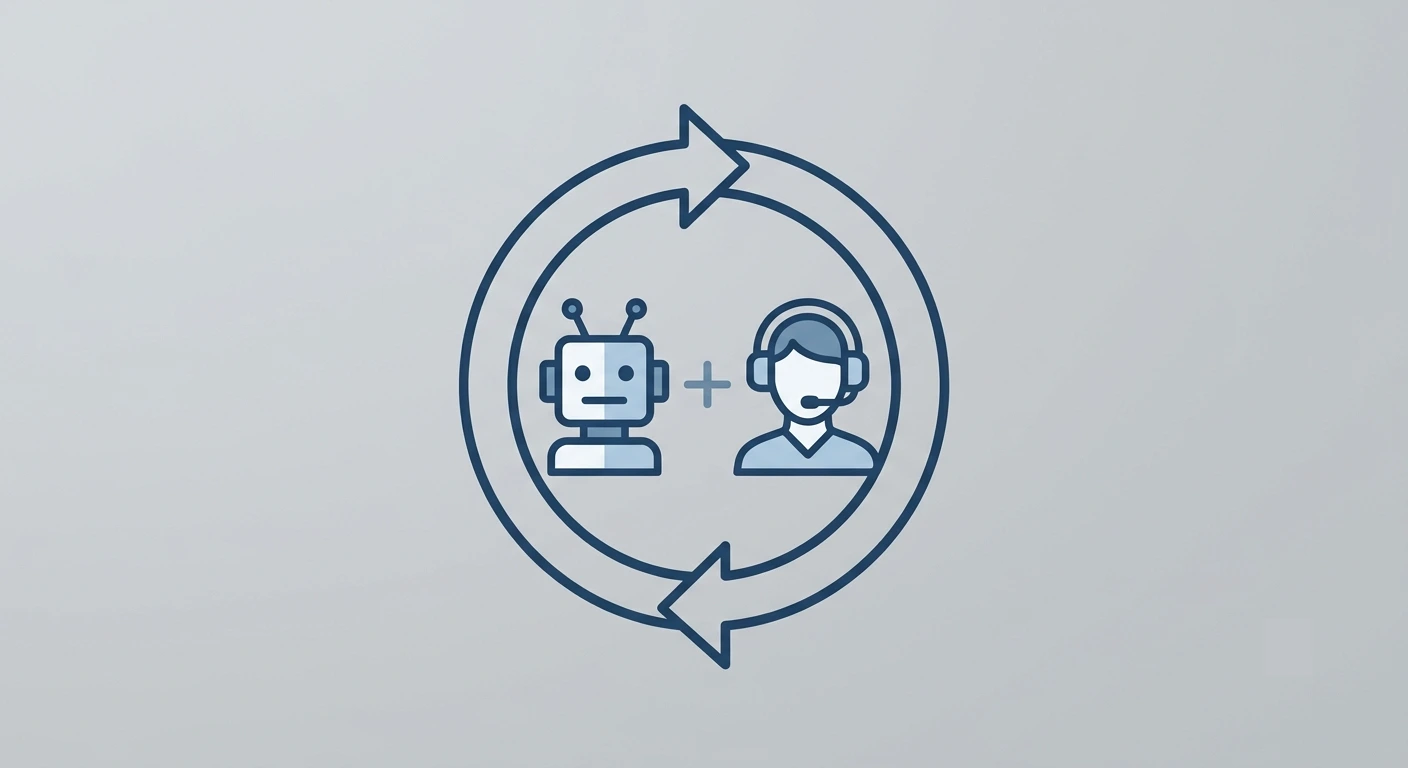
The most efficient enterprise operations don't view humans and AI as opposing forces. Instead, they leverage a human + AI support architecture. This is best visualized as a continuous data pipeline: a four-phase loop where human expertise trains the AI, the AI handles the repetitive volume, and humans are freed up to handle edge cases, which in turn generates new training data.
Here is the exact blueprint for constructing this scalable operational workflow.
Phase 1: Human Operations (The Foundation of Logic)
Everything begins with human intelligence. Before any algorithm can successfully resolve a ticket, your human operations team must set the standard for what a "perfect" resolution looks like.
In this initial phase, highly skilled support professionals handle the complex, nuanced, and emotionally charged interactions. They navigate your internal software, bend policies when context demands it, and de-escalate frustrated users. This phase is not a cost center; it is a data-generation engine. Every interaction, every keystroke, and every decision made by your human team establishes the baseline of empathy and operational logic that your AI will eventually inherit.
Phase 2: Data Labeling and Context Curation
Raw human interactions are messy. A transcript of a highly successful support call contains filler words, typos, and unstructured logic. For a machine to learn from this, the data must be refined.
This is where Phase 2 bridges the gap between human intuition and machine execution. Specialized teams take the highest-quality resolutions from Phase 1 and engage in meticulous data labeling. They categorize intents, highlight the specific context clues that triggered a specific workflow, and map the emotional sentiment of the user.
By translating human expertise into beautifully structured, high-signal data, you ensure that your future automation is trained on your company's absolute best practices, rather than generic internet data. This curation is the secret ingredient to intelligent customer support.
Phase 3: Continuous LLM Training
Once your data is structured, it is fed into your proprietary AI models. But this is not a one-and-done software update; it is an ongoing, dynamic process of Continuous LLM (Large Language Model) Training.
Because your human agents are constantly encountering new edge cases—a new product launch, an unexpected shipping carrier strike, a localized software outage—they are constantly generating new data. This data is labeled and fed back into the model in real-time.
This phase ensures your AI remains deeply context-aware. If a new refund policy goes into effect on Tuesday, the model is fine-tuned on how your human agents communicated that policy on Wednesday. The AI becomes a living, breathing extension of your best operational managers, capable of adapting to shifting business realities without missing a beat.
Phase 4: Automated Deployment (The Smart Engine)
Finally, the trained AI is deployed to the front lines. But because it has been rigorously trained on your authentic, human-generated data, it behaves entirely differently than a standard bot.
In Phase 4, the AI powers sophisticated automated ticket management. It can accurately identify user intent, extract relevant account data from your CRM, and execute complex workflows. If it encounters a ticket it is 99% confident it can resolve—like processing a routine return or updating an account address—it handles it instantly and flawlessly.
More importantly, it knows what it doesn't know. If the AI detects high emotional distress, a high-value VIP account, or a novel edge case it hasn't been trained on, it seamlessly and silently routes the ticket to a human agent, complete with a summarized brief of the customer's intent.
The human agent resolves the novel issue, generating new data... and the pipeline feeds back into Phase 1.
Achieving True AI Workflow Optimization
The beauty of the human-in-the-loop pipeline is that it accelerates over time. As the AI takes on more of the routine volume, your human agents are freed from the grueling, repetitive tasks that cause burnout.
This unlocks true AI workflow optimization across your entire enterprise:
- Drastic Cost Reduction at Scale: Your cost-per-ticket plummets as the AI confidently absorbs 40%, 60%, and eventually 80% of your tier-1 volume.
- Elevated Human Roles: Your support staff transitions from reactive ticket-takers to proactive brand ambassadors and data-curators. They focus on complex problem-solving, relationship building, and account expansion.
- Uncompromising CSAT: Because the AI only handles what it knows perfectly, and humans handle the nuanced exceptions, customers receive fast, accurate, and deeply empathetic support every single time. Resolution times drop from days to seconds.
When operations are structured this way, rapid business growth is no longer a localized liability. You can double your customer base without doubling your headcount, all while actually improving the quality of your customer experience.
The Bottom Line
Deploying an off-the-shelf chatbot is easy, but it is fundamentally a band-aid solution that ignores the complexities of modern enterprise support. Context is the currency of customer satisfaction, and context can only be built through a deliberate, human-centric architectural framework.
By committing to the four-phase data pipeline—Human Ops, Data Labeling, Continuous Training, and Automated Deployment—you stop playing defense with your support queue. You build an intelligent, scalable ecosystem that protects your margins, empowers your workforce, and turns your customer support department into a strategic engine for growth.
Ready to stop frustrating your customers and start building your own scalable automation workflow?
Don't settle for context-blind bots. Book a discovery call with AYSO Operations today to see how our fully managed human-first infrastructure can transform your customer experience, eliminate operational liabilities, and seamlessly scale your enterprise.